By A.D. Check, MPH | Updated March 2026 | Power Outages
Estimated reading time: 15 minutes
Introduction
It happens without warning.
One moment you’re making dinner, helping with homework or watching TV — and then everything goes dark. No lights. No refrigerator hum. No Wi-Fi. Just silence and the slow realization that you have no idea how long this is going to last.
For most families, a power outage triggers an immediate wave of questions: Is the food in the fridge still safe? How do we keep the kids calm? What if it lasts more than a day? Do we even have flashlights?
Here’s the truth: power outages are one of the most common emergencies American families face — and one of the easiest to prepare for. You don’t need a bunker, a generator the size of a car or months of freeze-dried food. What you need is a simple, practical plan built around the realistic needs of your family.
That’s exactly what this guide gives you.
As a public health professional, I’ve spent years helping families understand that preparedness isn’t about fear — it’s about confidence. When you know what to do before, during and after a power outage, you stop reacting and start responding. And that makes all the difference.
Let’s build your plan.
Part 1: Before the Power Goes Out — How to Prepare Your Family
The best time to prepare for a power outage is right now, when everything is working fine and there’s no pressure. Here’s what every family should have in place before the lights ever go out.
Build Your Power Outage Supply Kit
You don’t need to spend a fortune or buy everything at once. Start with the basics and build from there.
Lighting
- At least 2 flashlights with extra batteries (one per floor of your home)
- Battery-powered or hand-crank lanterns for common areas
- Glow sticks for kids — they’re safe, fun and last for hours
- Headlamps for adults who need hands-free lighting
Power & Communication
- A portable battery bank (power bank) to charge phones — aim for at least 20,000mAh capacity
- A battery-powered or hand-crank NOAA weather radio
- A car charger for your phone as a backup
- Printed list of important phone numbers (don’t rely on your phone’s memory)
Food & Water
- At least 1 gallon of water per person per day for 3 days minimum
- Non-perishable foods that don’t require cooking: canned goods, peanut butter, crackers, granola bars, dried fruit
- A manual can opener (this gets forgotten more than you’d think)
- Paper plates and plastic utensils so you’re not washing dishes without hot water
Health & Safety
- A basic first aid kit
- A 7-day supply of any prescription medications your family takes
- Baby supplies if you have an infant: formula, diapers, wipes
- Pet food and water if you have animals
Comfort & Sanity
- Extra blankets and warm layers
- Board games, cards and activities for kids
- A small amount of cash — ATMs don’t work without power
Know Your Home’s Power Setup
Take 10 minutes now to locate and understand these things:
Your circuit breaker box — Know where it is and how to reset a tripped breaker. Label each circuit if they aren’t already labeled.
Your water heater — If you have an electric water heater, you’ll lose hot water during an outage. Gas water heaters usually keep working.
Medical equipment — If anyone in your home depends on electrically powered medical equipment (CPAP, home oxygen, dialysis), contact your utility company now. Most have medical baseline programs and priority restoration lists for customers with medical needs.
Your garage door — Electric garage doors won’t open during a power outage unless you use the manual release cord. Find it now, before you need it in the dark.
Make a Family Communication Plan
If a power outage happens while your family is separated — kids at school, spouse at work — you need a plan for how you’ll reach each other and where you’ll meet.
- Designate an out-of-area contact everyone can check in with (sometimes local calls fail but long distance works)
- Choose a meeting place close to home if you can’t reach each other
- Make sure school-age children know their home address and a parent’s phone number by memory
- Keep your phone charged above 50% whenever possible
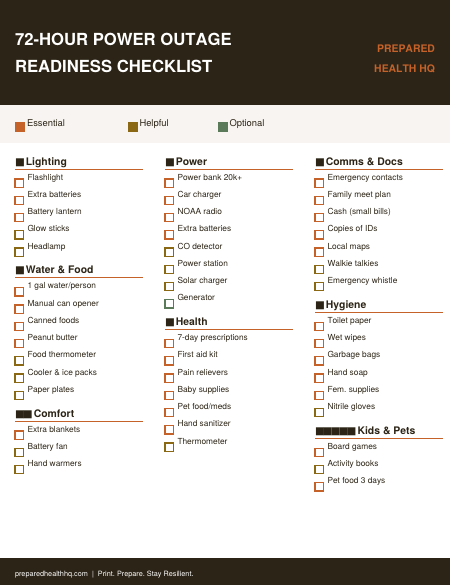
The 72-Hour Power Outage Readiness Checklist
A concise, easy-to-use printable checklist covering everything your family needs for the first 72 hours of a power outage — organized by category and color-coded by priority. Takes less than 5 minutes to review.
→ Download Your Free Checklist
Join everyday families building their basic preparedness plan — no extreme measures required.
Part 2: During a Power Outage — What to Do When the Lights Go Out
The power just went out. Here’s exactly what to do, in order.
Step 1: Stay Calm and Assess the Situation (First 5 Minutes)
Take a breath. Your first job is to stay calm — especially if you have children watching your reaction.
- Check if neighbors also lost power or if it’s just your home (if just yours, check your circuit breaker first)
- Report the outage to your utility company via their app or phone number — have this saved in your contacts now
- Check weather and news on your phone or battery radio to understand what caused the outage and how long it might last
- Grab your flashlights and set up your battery lanterns in key areas
Step 2: Protect Your Food (First 30 Minutes)
Food safety is one of the biggest concerns during a power outage and most families don’t act fast enough.
The rules are simple:
- Refrigerator: Keep the door closed as much as possible. A full refrigerator will stay cold enough for 4 hours if unopened. A half-full refrigerator for about 2 hours.
- Freezer: A full freezer stays frozen for 48 hours if unopened. Half full stays frozen for 24 hours.
- When in doubt, throw it out — food poisoning is a real risk and not worth it
Use a food thermometer to check temperatures when power returns. Refrigerated food should be at 40°F or below. Frozen food that still has ice crystals is generally safe to refreeze.
What to eat first:
- Foods from the refrigerator (most perishable)
- Foods from the freezer
- Non-perishable pantry foods last
Step 3: Manage Your Home’s Temperature
In winter:
- Close off rooms you aren’t using to retain heat in a smaller space
- Layer clothing and use blankets — your body is your best heat source
- Let sunlight in during the day by opening south-facing curtains
- Never use a gas stove, charcoal grill or camping stove indoors for heat — this is a leading cause of carbon monoxide poisoning during outages
- If the temperature inside drops below 55°F, consider going to a warming center, hotel or family member’s home
In summer:
- Move to the coolest room in the house (usually the lowest floor)
- Use battery-powered fans
- Stay hydrated
- Check on elderly neighbors and family members — heat is dangerous for older adults
- If temperatures are extreme, go to a cooling center or air-conditioned public space
Step 4: Keep Kids Calm and Occupied
For children, a power outage can feel scary or exciting depending on how you frame it. Lead with calm confidence.
- Turn on glow sticks or battery lanterns to make the dark feel fun rather than frightening
- Pull out board games, cards or activity books
- Tell stories by flashlight
- Let older kids help with age-appropriate tasks — feeling useful reduces anxiety
- Maintain normal routines as much as possible, especially bedtime
Step 5: Use Your Phone Wisely
Your phone is your lifeline but the battery won’t last forever.
- Put your phone on low power mode immediately
- Turn off Wi-Fi (it drains battery searching for networks that aren’t working)
- Reduce screen brightness
- Prioritize calls and texts over social media
- Use your battery bank to recharge
- Text instead of call when possible — texts use less power and often go through when calls can’t
Generator Safety (If You Have One)
If you have a portable generator, follow these rules strictly:
- Always run generators outside — at least 20 feet from windows and doors
- Never run a generator in a garage even with the door open
- Carbon monoxide poisoning from generators kills dozens of Americans every year — install a battery-powered CO detector if you have a generator
- Use heavy-duty, outdoor-rated extension cords
- Never plug a generator directly into a wall outlet — this is called backfeeding and can electrocute utility workers
Part 3: After the Power Comes Back — Recovery Steps
The lights are back on. Here’s what to do before you breathe a full sigh of relief.
Check Your Food
Before eating anything from the refrigerator or freezer, check temperatures with a food thermometer.
- Refrigerator: Any food that has been above 40°F for more than 2 hours should be discarded
- Freezer: Food with ice crystals is generally safe. Food that has thawed completely should be evaluated carefully — when in doubt, throw it out
- Check for unusual odors, colors or textures — trust your instincts
Reset Your Electronics Carefully
When power returns, it sometimes comes back with a surge that can damage electronics.
- Wait a few minutes before turning major appliances back on
- Use surge protectors for computers, TVs and other sensitive electronics
- Reset clocks, thermostats and programmable devices
Check Your Home for Damage
Especially after a storm-related outage:
- Check your basement or crawl space for flooding
- Look for downed power lines outside — never touch or approach them
- Check smoke and carbon monoxide detectors and replace batteries if needed
- If you smell gas, leave immediately and call your gas company from outside
Restock and Review
After every power outage — no matter how short — take a few minutes to restock and review your supplies:
- Replace used batteries, flashlight bulbs and food items
- Note what you wished you had and add it to your kit
- Talk with your family about what worked and what didn’t
- Update your emergency contact list if needed
Get Your Free 72-Hour Power Outage Readiness Checklist
Now that you know what to do before, during and after a power outage, make sure your family has everything they need. Our concise, easy-to-use checklist is organized by priority so you know exactly where to start — no overwhelm, no extreme measures.
→ Download Your Free Checklist Now
It takes less than 5 minutes to download and could make all the difference when the lights go out.
Conclusion: Preparedness Is an Act of Love
Getting your family ready for a power outage isn’t about fear or worst-case thinking. It’s about love. It’s about knowing that when something unexpected happens — and it will — your family will be okay because you took a little time to prepare.
You don’t need to do it all at once. Start with a flashlight and some extra batteries. Build from there. Every small step you take is one less thing to worry about when the lights go out.
You’ve got this.
Frequently Asked Questions
How long do most power outages last?
According to the U.S. Energy Information Administration, most power outages last less than 4 hours. However outages caused by major storms or infrastructure damage can last days or even weeks, which is why having at least a 72-hour supply kit is recommended.
Is it safe to eat food that was in the fridge during a power outage?
Generally yes, if the outage lasted less than 4 hours and the refrigerator door stayed closed. Food held above 40°F for more than 2 hours should be discarded. Always use a food thermometer to check.
Do I need a generator?
Not necessarily. A good battery bank, battery-powered lanterns and a well-stocked supply kit will get most families through a typical outage comfortably. Generators are a valuable addition for longer outages or families with medical equipment needs, but they are not essential for basic preparedness.
What about my pets during a power outage?
Keep extra pet food, water and any medications your pet needs in your supply kit. In extreme heat or cold, pets need the same temperature protections as people.
How do I keep my kids calm during a power outage?
Frame it as an adventure rather than an emergency. Glow sticks, flashlight stories and board games go a long way. Children take their emotional cues from parents, so staying calm yourself is the most important thing you can do.